Diamond Radar Sees the Roster Update Coming
What our roster-update projection tool actually does — and why it keeps getting sharper every cycle.
If you're deep in the Live Series collection grind, you already know the math: every card you still need is a stub decision, and the smartest stubs you'll ever spend aren't on what's expensive today — they're on what's about to be. The next roster update is the best investment window The Show hands you, and unlike a flash sale or a program drop, it's one you can actually get ahead of.
Here's how it pays. Every roster update, a handful of players get attribute bumps — and their cards rip on the market the second SDS posts it. The grinders who already had those cards stacked make stubs. Everyone else pays the new price. Diamond Radar's entire job is to put you in the first group: it tells you who's trending toward a bump before it's official, while the card is still cheap enough to flip. That's the whole pitch. Everything below is just detail.
 Diamond Radar, top of the board. Every row is a projected roster-update move — who's trending up, how confident, and what the bump is worth.
What it actually does
Diamond Radar projects which players are trending toward an upgrade in the next roster update, which direction they're moving, and how confident we are about it. Names, direction, a confidence read. That's the product.
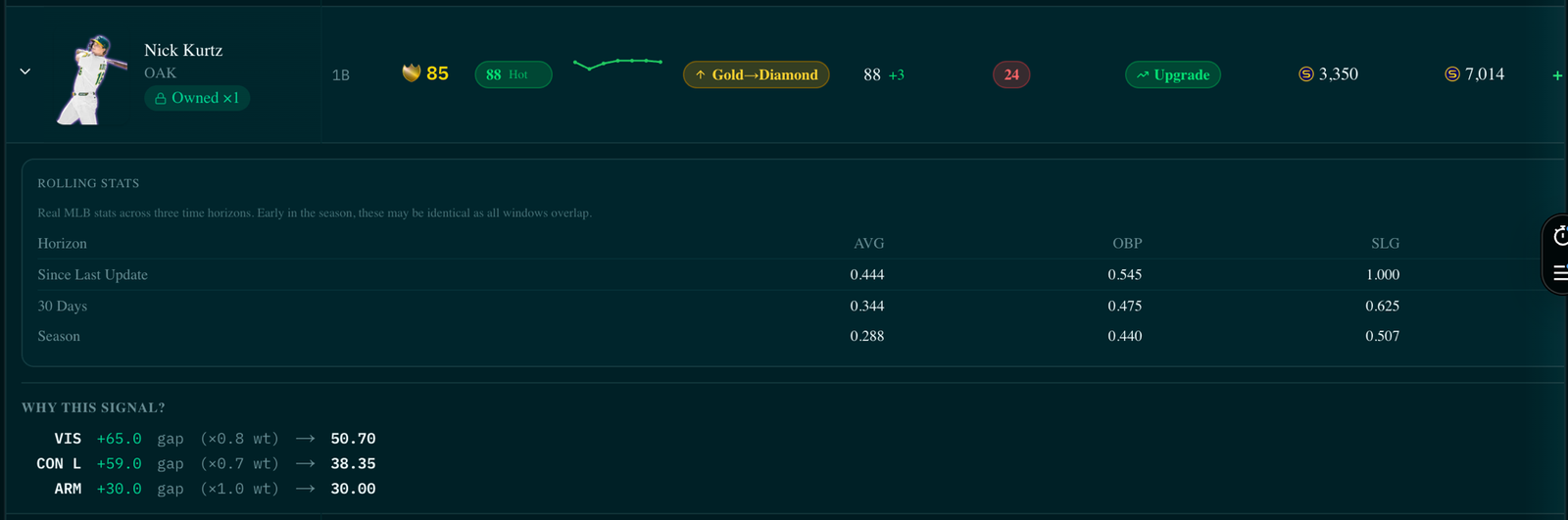 One call, opened up: Nick Kurtz, 85 → 88, Gold → Diamond. The signal, the real on-field stats behind it, and the gap between today's Buy Now and the post-bump price.
Why that matters in The Show: the stubs aren't in reacting to the roster update. By the time the update drops and the card jumps a tier, the market has already eaten the move — you're buying the top. The profit is in being early, buying the OVR bump before it happens, and selling into the spike SDS hands you. Diamond Radar exists to put you on the right side of that flip while there's still a flip left to make.
"Okay, so how does it work?"
I'm going to disappoint you slightly: I'm not going to give you the full recipe.
Here's what I'll say. Diamond Radar watches what's actually happening on the baseball field and turns it into a projection. Real on-field performance is the thing SDS itself leans on when it builds a roster update, so we track it, weigh it, and turn it into "this guy is trending toward a bump." The specific signals — and exactly how they're weighted — are the part that took months to get right. That's the engine, and it stays under the hood.
What you get is the output: the call, and how confident we are in it. That's the part that's useful to you anyway.
The part I'll actually brag about: it gets smarter
Every roster update is a graded test. The update drops, we line up what Diamond Radar projected against what actually happened, and the model recalibrates on the gap.
So the Diamond Radar reading the field today is sharper than the one from three updates ago — and the one three updates from now will be sharper still. It compounds. Every cycle it's wrong is a cycle it learns from; every cycle it's right is a pattern it keeps. You don't lift a finger to benefit from that — you just get a better tool every time the league plays more baseball.
On its last graded window, Radar ran 76.7% precision — when it called an upgrade, it was right roughly three times out of four. Not perfect, and I'll never tell you it is. But "right three out of four, early every time" is a number you can build a bankroll on.
How to read it (a projection is not a prophecy)
Diamond Radar gives you a confidence read for a reason. A high-confidence call is a different bet than a coin flip, and you should size your stubs accordingly — back up the truck on the strong reads, dabble on the speculative ones.
And yes, it'll miss sometimes. So will you. The point was never to be right every time — it's to be early often enough that the wins bury the misses. Certainty doesn't exist in a card market; being early and usually right does.
What Diamond Radar is calling right now
Ahead of the next roster update, here's what's near the top of the board — and, just as important, still cheap enough to matter. A call only prints stubs if the market hasn't already priced it in, so I'm pulling the ones Radar still tags a strong buy: real headroom left between today's price and where the bump would put them. The names that already ran? Too late — those are someone else's profit now.
 The board, filtered to projected tier jumps. Read the Buy Now column against Post-Upgrade — that gap is the trade, and it's still open on every one of these.
- Nick Kurtz (1B, OAK) — 85 → 88, Gold → Diamond. A position player crossing into Diamond is about the most market-moving thing a roster update can do: a Diamond 1B is lineup-relevant, collection-relevant, and priced like it. Radar still rates it a strong buy — today's Gold price hasn't caught up to where a Diamond 1B trades, and that gap is the trade.
- Braxton Ashcraft (SP, PIT) — 78 → 81, Silver → Gold. A Gold starter is a card people actually run; the cheap Silver tag it's wearing today is your entry, and Radar still has it flagged a strong buy with room to move.
- Fernando Cruz (RP, NYY) — 77 → 80, Silver → Gold. A Gold reliever on a contender, still wearing a Silver price — Radar's got it a strong buy with the Buy Now sitting well under the post-bump price. Cheap entry, clean room to run.
A word on what isn't here: the single loudest signal on the board right now is a card I'm not telling you to buy. Its price already ran past where the bump would land — buy in today and you'd pay more than the upgrade is worth. That's the whole discipline. A loud signal tells you a card is moving; the value gap tells you whether there's any money left in it. Radar shows you both, so you don't buy someone else's exit.
Those are the headliners, but the board runs deeper than the top three — there are cheaper Silver-to-Gold and Bronze-to-Silver strong-buys sitting on it too, the kind of low-entry flips that don't dent a collection budget. Whatever you're working with, the point's the same: get in while it's still priced like the old card.
I'm not going to tell you why Radar likes these — that's the part I keep. But the calls themselves are sitting on Diamond Radar right now, free to look at.
Don't take my word for it. Pull up Diamond Radar and look for yourself — before the roster update lands, not after, when the prices already told the story without you.
The roster update is coming whether your lineup is ready or not. Diamond Radar is how you're ready.
Read next
Diamond Dynasty Has Great Tools. I Kept Wanting More.
Who I am, what DiamondOps actually is, and why it's not trying to replace anything you already use.
OVR Is a Polite Fiction. Here's What We Use Instead.
What OpScore is, what it isn't, and how to read it.