Scout Your Opponents — and Yourself
Gamertag Scout sizes up anyone before first pitch. My Games turns your own game data into real scouting intelligence — split by human vs CPU, online vs offline, and card by card.
I built this because I had a question I couldn't answer: do I actually hit better with high-vision guys on Legend than on All-Star? Where's the cutoff — does vision below 75 stop mattering on lower difficulties, and start mattering a lot once the CPU pitching gets nasty? I wanted to pick cards by how I actually perform with them at the level I'm playing, not by the overall on the front of the card. Diamond Dynasty gives you a box score and a win-loss record. It doesn't answer any of that.
So I started pulling my own game data apart. That's what became these two tools: Gamertag Scout for sizing up an opponent before first pitch, and My Games for understanding yourself — both built on the same engine that turns raw box scores into scouting intelligence.
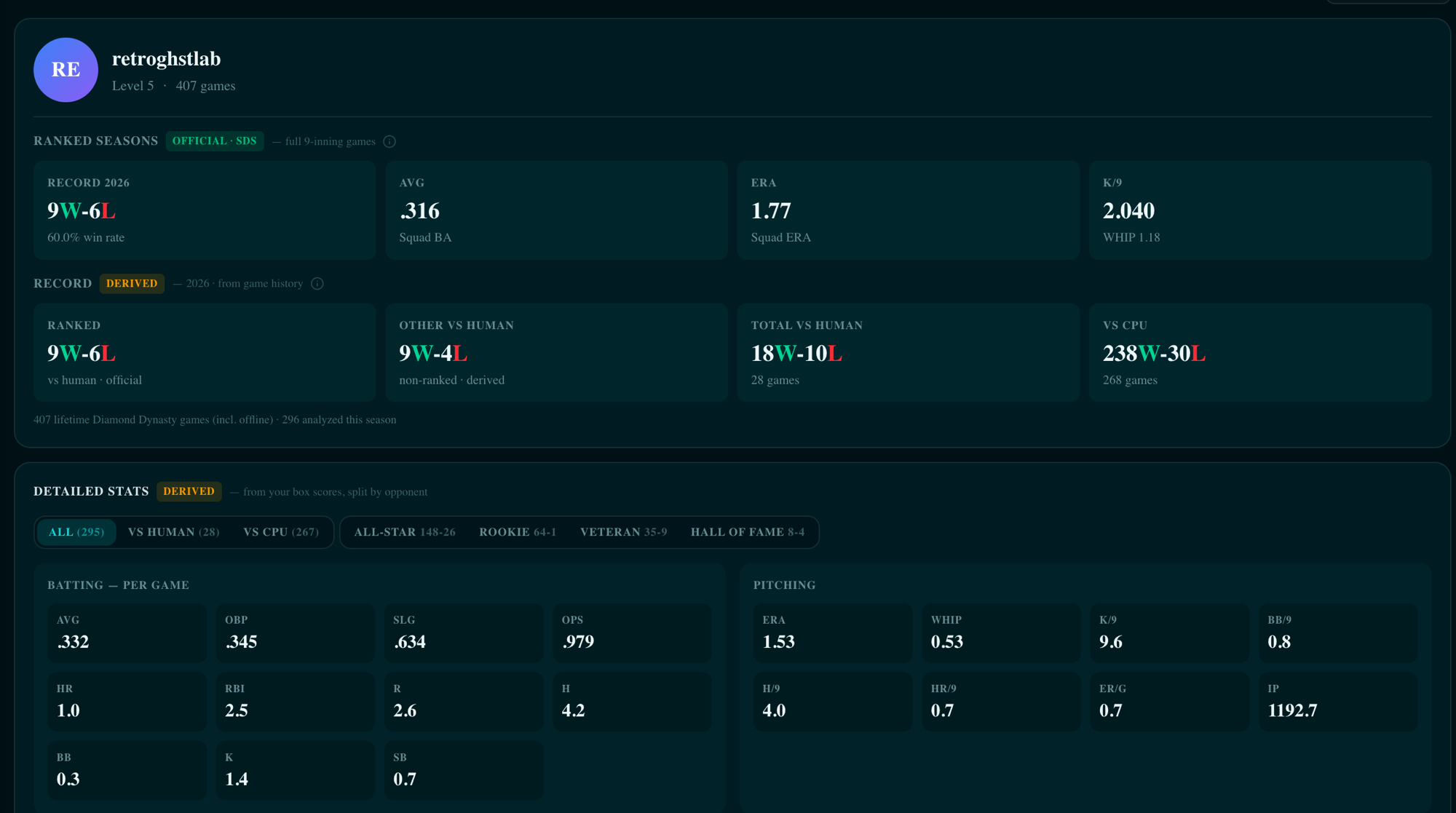 Your record and stats, split the way they actually matter: official Ranked Seasons, derived vs-human and vs-CPU, and per-game batting/pitching by opponent.
Gamertag Scout: know the matchup before first pitch
Type in any player's gamertag and DiamondOps pulls their public Diamond Dynasty record into one scouting view — overall record, recent form, and the profile of how they actually play.
The point isn't to read a number and feel good or bad about it. It's context. A player with a sky-high record against the CPU but a thin online history is a different threat than someone grinding Ranked Seasons every night. Recent form tells you whether they're hot or pressing. Strike-zone tendencies tell you where they chase and where they sit. You walk into the game with a plan instead of finding out in the fifth inning.
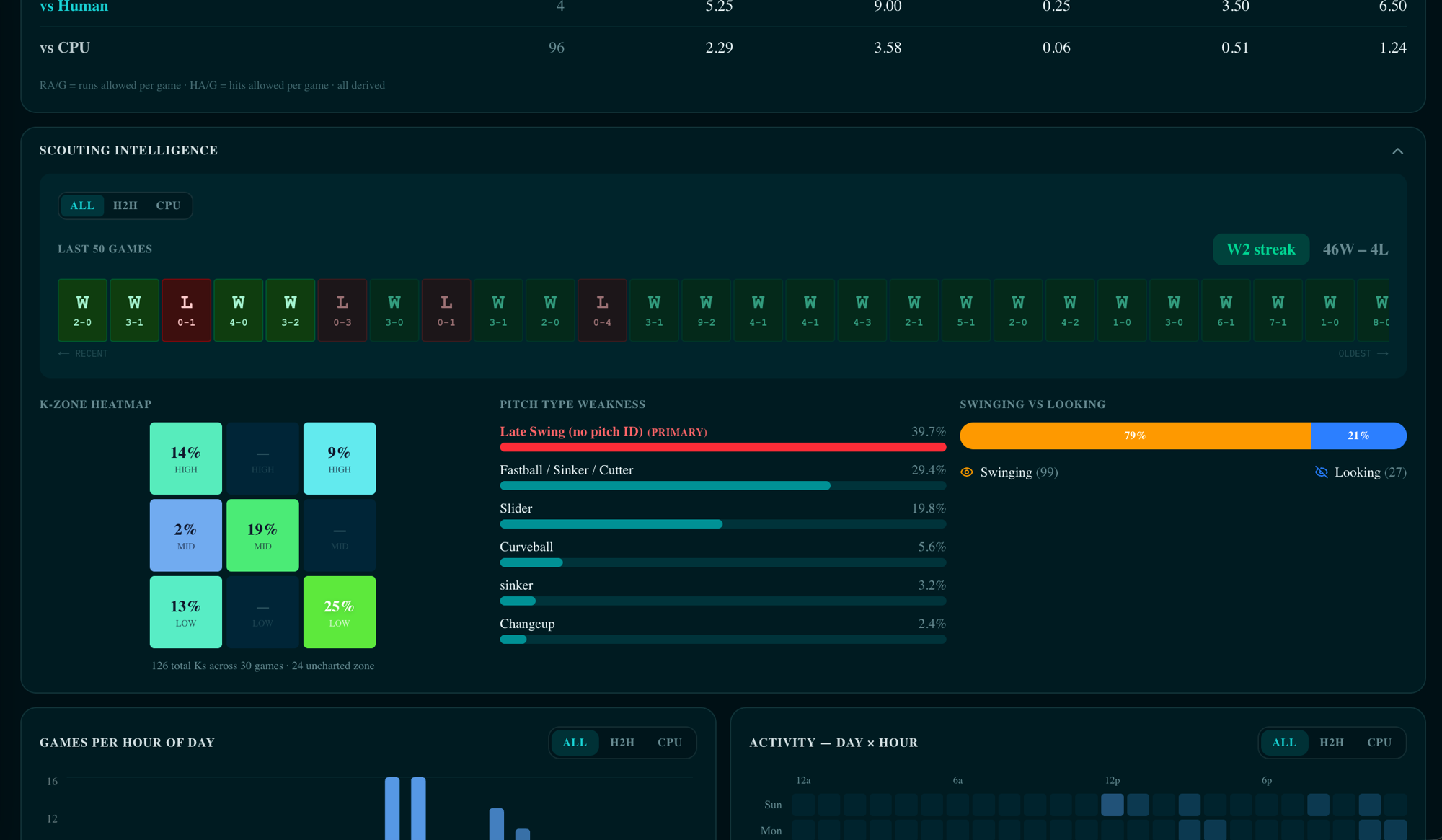 Scouting Intelligence: recent form, where they chase in the zone, which pitches give them trouble, and how often they swing vs take.
My Games: the same lens, pointed at you
My Games runs your own history through the same engine — with far more depth, because it's your data. Link your gamertag and you get your activity patterns, win-rate trends, most-used players, and a full derived stat line built from the games you've actually played.
This is where it gets useful for getting better. Your overall numbers hide as much as they show. My Games pulls them apart.
How we derive your stats — and why the splits matter
A single batting average across every game you've ever played is close to meaningless, because you're averaging completely different contexts together. Beating up on the CPU is not the same as grinding out wins against real humans online. So we don't lump them together — we derive your stats across the splits that actually change how you should read them:
- Vs Human vs Vs CPU. Your line against real opponents is the honest one — it's what predicts how you'll do in Ranked. Your CPU line shows how you play when the pressure's off. When the gap between them is large, that gap is the insight: it usually means nerves, not skill, are costing you online.
- Online vs offline. Ranked Seasons and Events play differently from offline modes. Splitting them keeps your competitive numbers from being diluted by casual reps.
- Per-player, with your card. My Games shows your line with each specific card you run — split the same way. The slugger who rakes against the CPU but disappears against humans is easy to spot once the data is separated, and it tells you who actually belongs in your lineup. This is also the first real piece of that vision-on-Legend question I started with: once you can see your line per card, you can start noticing which kinds of cards carry you at which level. (The full attribute-vs-difficulty breakdown — where the cutoffs actually are — is the next thing I'm building.)
We pull these straight from the box scores of your real games and roll them up, so the stats reflect how you play — not a league-wide average, and not a card's theoretical rating.
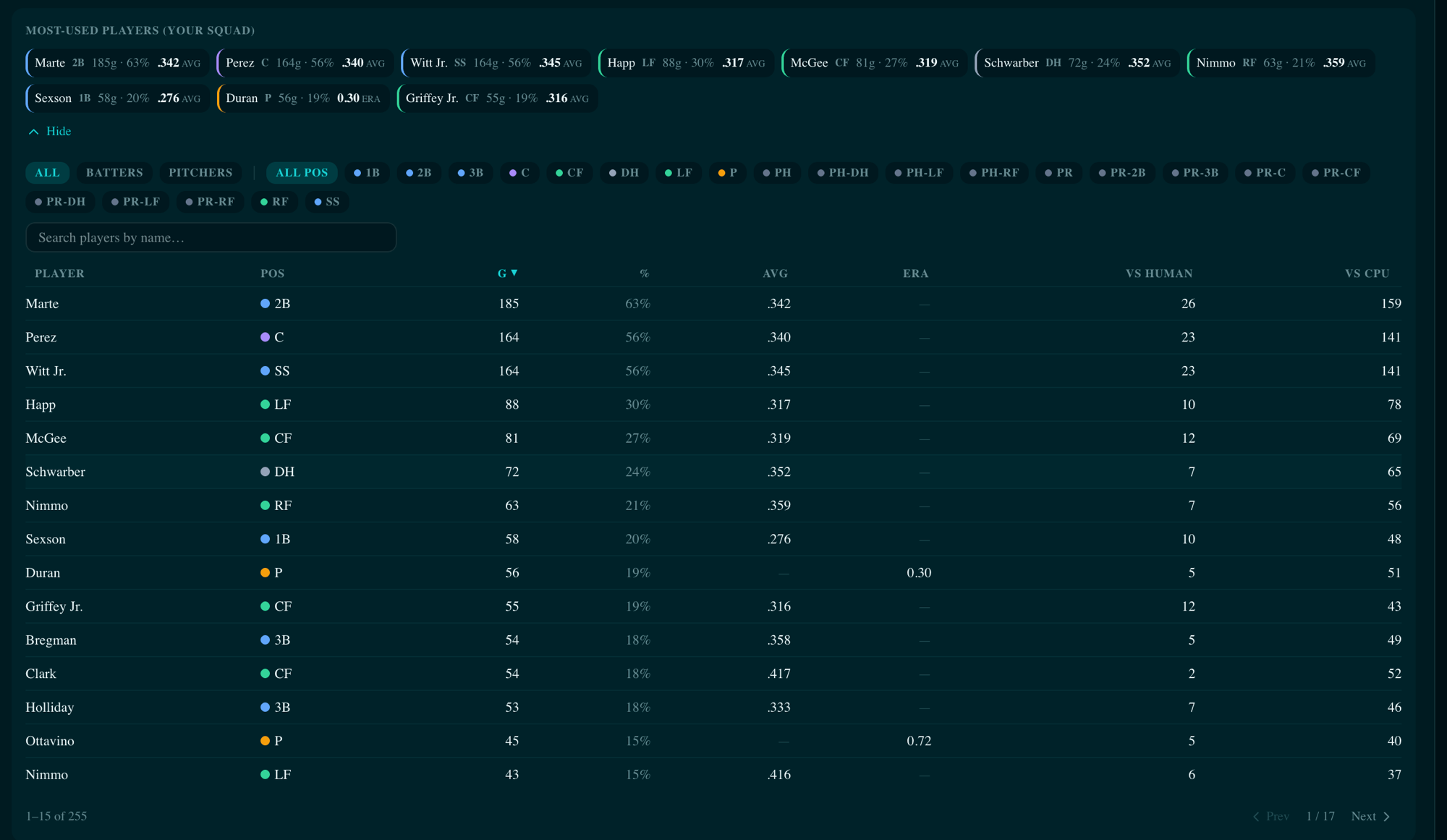 Every card you run, with its own line — AVG and ERA in their own columns, split by how many games came against humans vs the CPU.
What you actually gain from it
- Find the leak. A strong CPU line and a weak human line points at approach, not ability — and that's fixable.
- Build the right squad. Per-card splits show which cards perform for you in real games, regardless of overall. Sometimes your best card isn't your highest-rated one.
- Scout smarter. The same vocabulary that describes an opponent describes you — so you know your own tendencies as well as theirs.
- Track progress honestly. Win-rate trends and activity patterns show whether the grind is paying off, on the numbers that count.
Why it's worth syncing
Gamertag Scout works on public data for anyone. My Games and your derived stats need your own data — and the cleanest way to get it into DiamondOps is the Chrome extension. Create a free account, install the extension, and run a sync; from then on your inventory and game data flow into DiamondOps and the personal scouting layer lights up.
It's free, it's a couple of clicks, and it's the difference between a generic dashboard and one that actually knows your game.
Get the DiamondOps Chrome extension →
Then head to My Games and see your season the way a scout would. I'm still chasing that original question — where the attribute cutoffs really are, level by level — and the more games I have synced, the closer the answer gets.
Read next
Diamond Radar Sees the Roster Update Coming
What our roster-update projection tool actually does — and why it keeps getting sharper every cycle.
Diamond Dynasty Has Great Tools. I Kept Wanting More.
Who I am, what DiamondOps actually is, and why it's not trying to replace anything you already use.
OVR Is a Polite Fiction. Here's What We Use Instead.
What OpScore is, what it isn't, and how to read it.